



What is Space Situational Awareness (SSA)?
Space Situational Awareness (SSA) means being able to see, track, and study objects in orbit. This includes active and inactive satellites, debris, asteroids, and space weather. SSA keeps space activities safe and sustainable.
In recent years, the need to track and understand the space environment has grown a lot for many reasons.
- The proliferation of mega-constellations and the explosion in the number of objects in orbit:
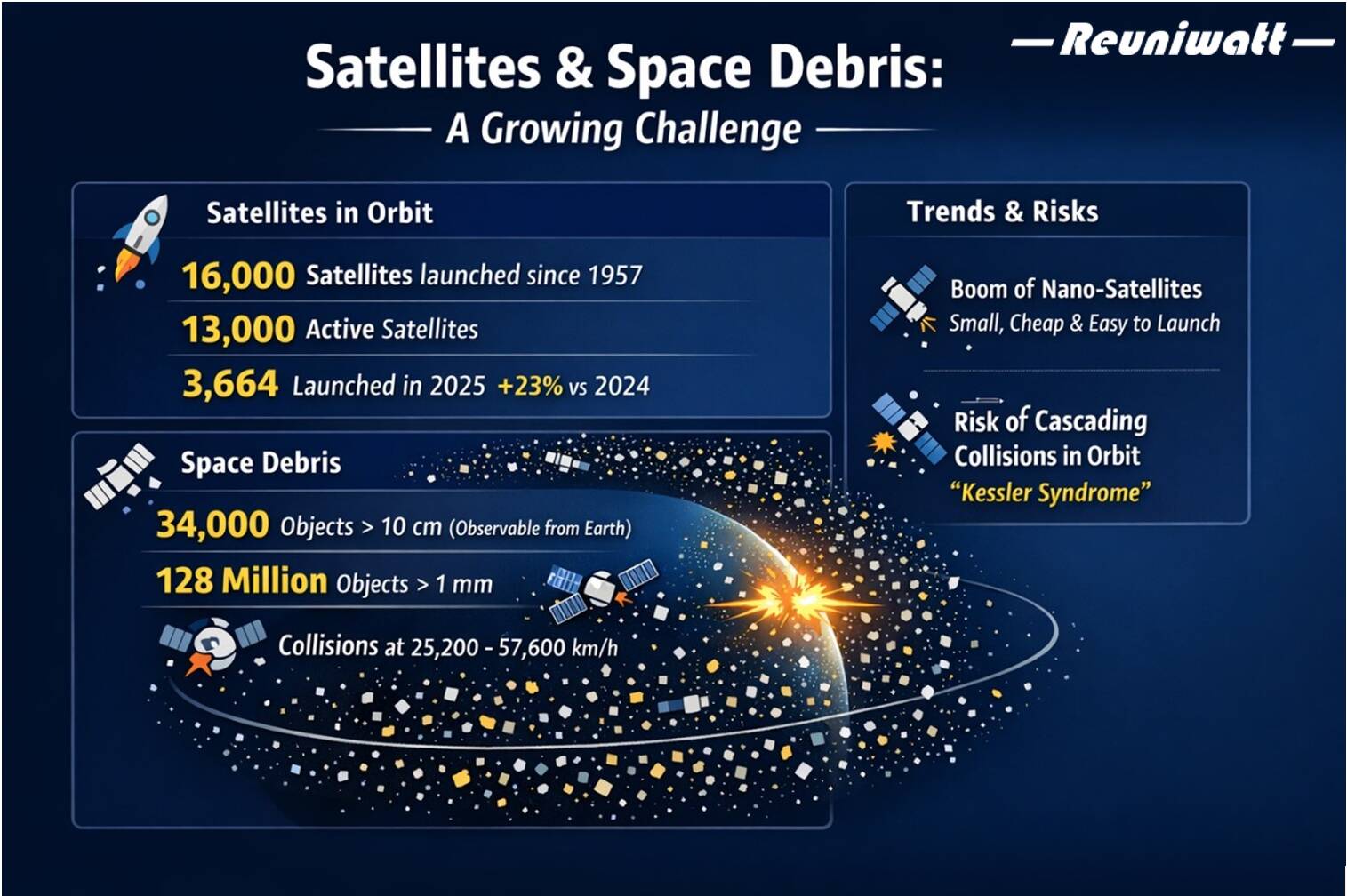
- This has led to an exponential number of space debris [3]:
- Upper stages, engines, inactive satellites, explosion fragments, etc.
- Collisions that happen between 7 and 16 km/s, or 25,200 and 57,600 km/h, create new debris. This is known as the Kessler syndrome. In this scenario, the number of objects in Earth’s orbit gets very high. When satellites collide, they create more debris. This can start a chain reaction of more collisions.
- Objects > 10 cm in orbit: 34,000 (including 10,000 active satellites), observable from Earth
- Objects > 1 mm in orbit: 128 million
Because of these two significant factors, states and private companies stressed the need to create services. These services should track, list, and classify every object in orbit and every event in outer space.
According to the ESA/EU SSA definition, the SSA has three segments [4]:
- Space Surveillance & Tracking: use of radars and telescopes to detect active and inactive satellites, spent launch vehicle upper stages, fragments from explosions and collisions, and other debris orbiting the Earth, and to predict possible collisions with operating satellites.
- Near-Earth Objects: searching for near-Earth objects such as asteroids that could collide with our planet, assessing their impact risk, and developing potential mitigation measures.
- Space Weather Events: use of a range of sensors on Earth and in space to monitor space weather: charged particles, ambient plasma, and electromagnetic radiation from the Sun that can affect satellites, aviation, navigation, power grids, and telecommunications.
SSA Market Growth
The proliferation of mega-constellations has led to increasing congestion in low orbit for various purposes, including communications, navigation, Earth observation, and scientific research.
This increases the risk of collisions and orbital incidents, requiring ever greater space surveillance and knowledge of its status and environment at any given moment. Among other things, these services ensure that satellites are safely positioned and protected against damage caused by physical interference (collisions) or electromagnetic interference (solar storms, jamming, etc.).
The global SSA market was valued at $1.55 billion in 2023 and is estimated to reach $1.69 billion by the end of 2025 and ~$2.3 billion by 2030, representing an average Compound Annual Growth Rate (CAGR) of 5% between 2025 and 2030.[5]
Several market growth drivers can be listed:
- The exponential growth in satellite launches, driven by technological advances and lower launch costs. This is generating an increase in space activity that requires monitoring.
- The impact of regulations is significant. Regulations play a key role in structuring the market, as they establish essential guidelines and standards for space activities. Stricter regulations can stimulate demand for more sophisticated situational awareness solutions to comply with safety and operational standards, thereby promoting innovation and growth in the sector.[6]
- The development of the “New Space”: nano satellites, with their reduced sizes, mean cheaper production and launch costs.
- The deployment of mega constellations, such as Starlink and its 7,800 satellites in LEO in 2025[7].
- Defence imperatives: in a changing and geopolitically driven world, space is becoming a civil and military playground that is essential to the independence of states. More spy satellites are being detected thanks to SSA, for example.[8]
Cloud observation and Forecasting for SSA: How it improves scheduling and optical ground station automation
SSA applications are divided between ground-based and space-based technologies. Ground-based systems make up about 70% of the total. Around 30% of these use visible or optical sensors. About 10% rely on laser technologies, mainly Satellite Laser Ranging.
One of the challenges of ground-based SSA is therefore the weather. 70% of the Earth’s surface is covered by clouds. Optical/laser ground sensors cannot see 100% through clouds and can be affected by strong winds.
Thus, monitoring the clouds and forecasting their upcoming arrival helps in several ways: identifying a clear line of sight, increasing telescope usage time, reducing costs, refraining from opening the dome in case of rain, relaying observations between stations.
Reuniwatt: a Space Situational Awareness Company
Sky InSight™ Infrared All-Sky Imager: Cloud Detection and Cloud-Base Insights
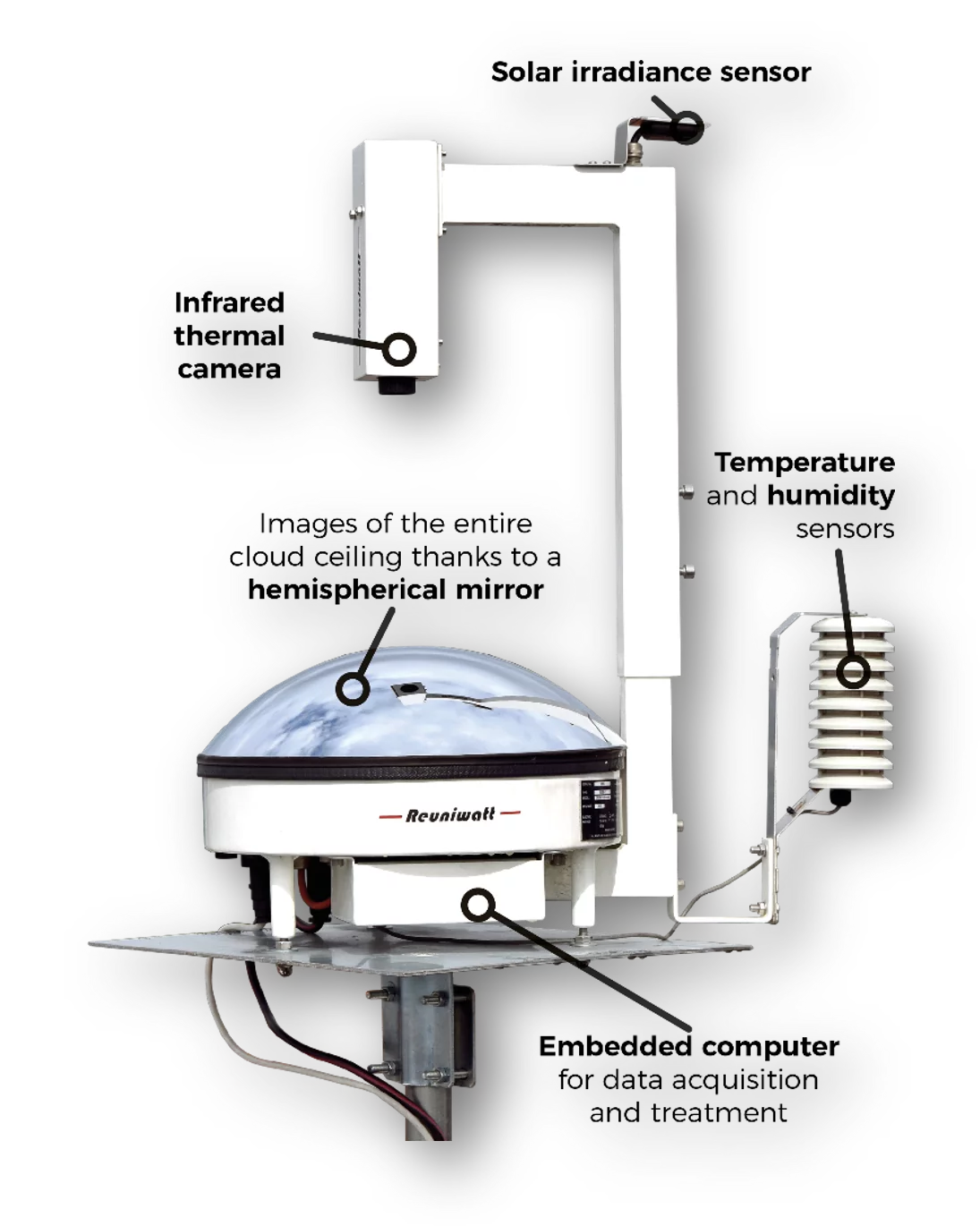
Sky InSight™ is a patented infrared all-sky imager developed by Reuniwatt for the continuous tracking and forecasting of the cloud cover. The use of the infrared vision technology enables an unprecedented accuracy for day & night cloud detection, while catching additional information on the cloud ceiling.
Sky InSight™ offers advanced possibilities in terms of cloud observation, including:
- Cloud type classification,
- Cloud-base height,
- Cloud optical depth,
- Optical attenuation maps,
- and more.
Sky InSight™ can then be used to improve strategic aspects of SSA:
- Evaluate and define clear lines of sight for observations
- Save observation time
- Schedule observation sessions and automated dome opening
- Plan the organisation of ground stations
- Maintain operational conditions over time through more efficient use.
This helps reduce operating costs. Placing a sky imager next to an optical ground station offers a simple, cost-effective way to improve SSA operations. By providing real-time insight into sky conditions, it reduces wasted observation time, minimises equipment strain, maximises data quality and reduces global costs. This investment delivers measurable operational savings, making optical observations more efficient and cost-effective.
Request a demo!
We help you assess your site and observation constraints. Interested in more information? Send us your site coordinates and a brief description of your instruments and operating routine. We’ll return practical recommendations for installation and operations, plus an estimate of how cloud nowcasting can improve session planning.
[1] Explosion du trafic orbital : 13 026 satellites actifs au 1/10/2025 – AeroMorning.com
[2] Explosion du trafic orbital : 13 026 satellites actifs au 1/10/2025 – AeroMorning.com
[3] Les débris spatiaux | CNES
[4] SSA | EU Agency for the Space Programme
[5] Space Situational Awareness Market Size, Share Report 2030
[6] The EU Space Act with its safety & sustainability pillar, is a good example. It is a proposed European Union regulation designed to create a harmonised legal framework for space activities across all EU member states, replacing fragmented national laws with common rules that make the internal space market simpler and more predictable. Its main goals are to enhance safety (e.g., tracking objects and reducing space debris), boost resilience (including cybersecurity protections for space infrastructure), and promote sustainability and competitiveness of the EU space sector while supporting innovation and cross-border business growth EU Space Act | EESC
[7] Starlink | Informations relatives au réseau
[8] Russian satellite unusual close approach – Aldoria — Space Technology